
Join us in celebrating the Indian Pueblo Cultural Center’s 50th anniversary through the stories, knowledge, and voices represented in 50 special books from the IPCC Library collection. This curated selection features titles for readers of all ages and interests, offering meaningful ways to explore, honor, and celebrate Pueblo culture.
Each week, for the remainder of 2026, we will spotlight one or two featured titles. The selected books are available to view in the IPCC Library Tuesday through Saturday, 9 a.m.–5 p.m.
Growing up on the edge of Laguna Pueblo, Leslie Marmon Silko spent a great deal of time with her great-grandmother, Marie Anaya Marmon. Silko is the daughter of noted photographer Leeland Howard Marmon and teacher Mary Virginia Leslie. Because her parents often worked away from home, Leslie and her sisters were primarily raised by their great-grandmother, whom they called "A'mooh." Leslie remembered using this name because she heard her great-grandmother say it whenever she saw her. A'mooh means "granddaughter" in Keres, the language spoken in Laguna Pueblo.
Drawing on her White American, Native American, and Mexican ancestry, Silko has shared that much of her writing explores the experience of growing up without a full connection to every part of her heritage. As a child, Silko recalls learning traditional Laguna stories from her grandmother A'mooh. This experience gave Silko her strongest sense of self. In a 1997 interview at Emory University, Silko shared that while her heritage came from many different places, her worldview would always be rooted in Laguna Pueblo's culture and traditions.
In 1969, Leslie graduated with a BA in English literature from the University of New Mexico and began her career as a writer and teacher. She would soon publish her first story, "Tony's Story," followed shortly afterward, in 1970, by the well-known short story "The Man to Send Rain Clouds." Ceremony, Leslie's breakout debut novel, was written in 1977. The success of this novel would lead to Silko being awarded a MacArthur Genius grant in 1981, the grant's inaugural year. Leslie was one of six women among the 41 recipients.
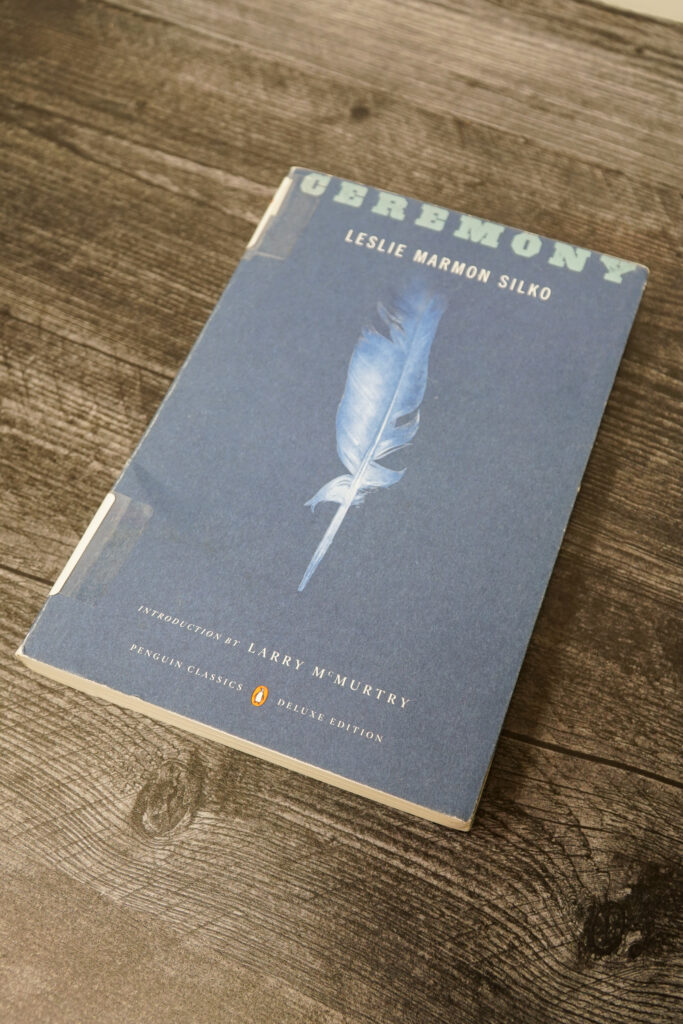
Ceremony
By Leslie Marmon Silko
Penguin Books, 2006
Silko sees her work on the novel Ceremony as a sort of life preserver. Having moved from the Southwest to Alaska, the writer found herself struggling with the constant dark and rain in her new home. To save herself, she began writing Ceremony to recreate a sense of where she belonged. At the time, she wasn't sure whether what she was writing could be considered a novel. Nonetheless, each day during the persistent gloom, she wrote about the Laguna-Acoma area, the sandstone, and the sun.
Published originally in 1977, Ceremony tells the story of Tayo, a mixed-heritage Laguna Pueblo World War II veteran who returns home haunted by combat in the Pacific. Suffering from severe post-traumatic stress disorder (PTSD), alienation, and a sense that his actions in the rain-soaked jungle have brought a drought upon his desert reservation, Tayo struggles to find peace.
Silko's debut novel was part of an increase in the publication of Indigenous literature following the 1968 publication of N. Scott Momaday's Pulitzer Prize-winning House Made of Dawn. Silko was among the authors associated with what critic Kenneth Lincoln termed the "Native American Renaissance" in 1983. Silko and other scholars have pushed back against this term, arguing that it implies a lack of previous Native literary and storytelling traditions. Instead, the author views her work as the continuation of oral storytelling and cultural traditions that have always been present, even when ignored by mainstream Western publishing.
"I think of storytelling as a part of healing. The body of healing stories and storytelling are held communally and are practiced together and always have been."
Ismail Ibrahim. "Leslie Marmon Silk Saw It Coming," The New Yorker, April 16, 2023.
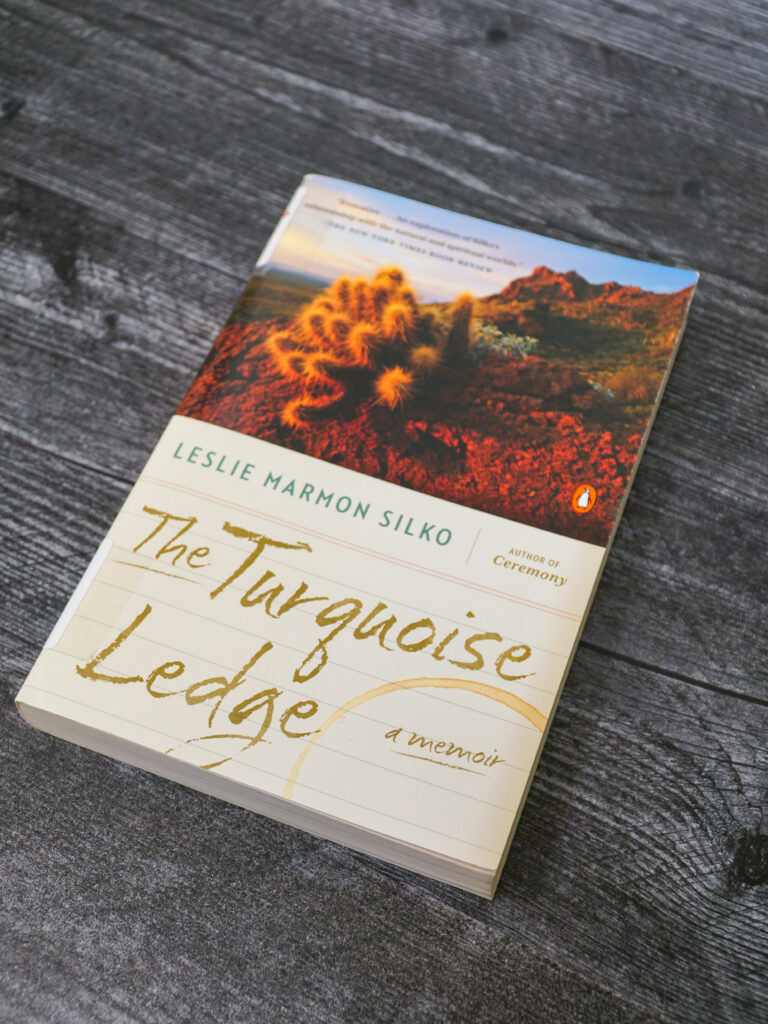
The Turquoise Ledge: A Memoir
By Lelie Marmon Silko
Penguin Books, 2010
Inspired by the many notes and journals she had kept and noticing how quickly the world seemed to be changing, Silko published her memoir, The Turquoise Ledge in 2010 in the hopes that younger generations would know that there were different ways of living.
Rather than writing a conventional chronological autobiography, Silko connects her daily life, her family history and Laguna heritage to her musings about the natural world. Framed through the lens of her daily speed walks through the Arizona desert with she lives, the author shares her observations of how landscapes have changed with the constant need to consume. Reflecting on the greed she has witnessed in the development around Tucson, Silko was moved to share her day journal-inspired connections to her past, the stories and traditions she grew up with, and the importance for everyone, even those who dwell primarily in a city setting, to understand how and why connections to nature matter.
"I make myself a fictional character so I can write about myself"
(Preface, The Turquoise Ledge: A Memoir, 2010)
For the past 50 years, Silko has shared her life experiences, creativity, and observations as an essayist, poet, and novelist. From the self-published multi-genre book Sacred Water: Narratives and Pictures (1993) to the early stories and poetry in her collection Storyteller (1981) and the shared inner thoughts of The Turquoise Ledge (2010) she has written in the only way she knows how: as herself.
We invite you to visit the IPCC Library to explore the work of Leslie Marmon Silko and many other wonderful authors. Come discover your next favorite read at the IPCC Library!