
Join us in celebrating the Indian Pueblo Cultural Center’s 50th anniversary through the stories, knowledge, and voices found in 50 special books from the IPCC Library collection. This curated selection features titles for readers of all ages and interests, offering meaningful ways to explore, honor, and celebrate Pueblo culture.
Each week, for the remainder of 2026, we will spotlight one or two featured titles. The selected books are available to view in the IPCC Library Tuesday through Saturday, 9 a.m.–5 p.m.
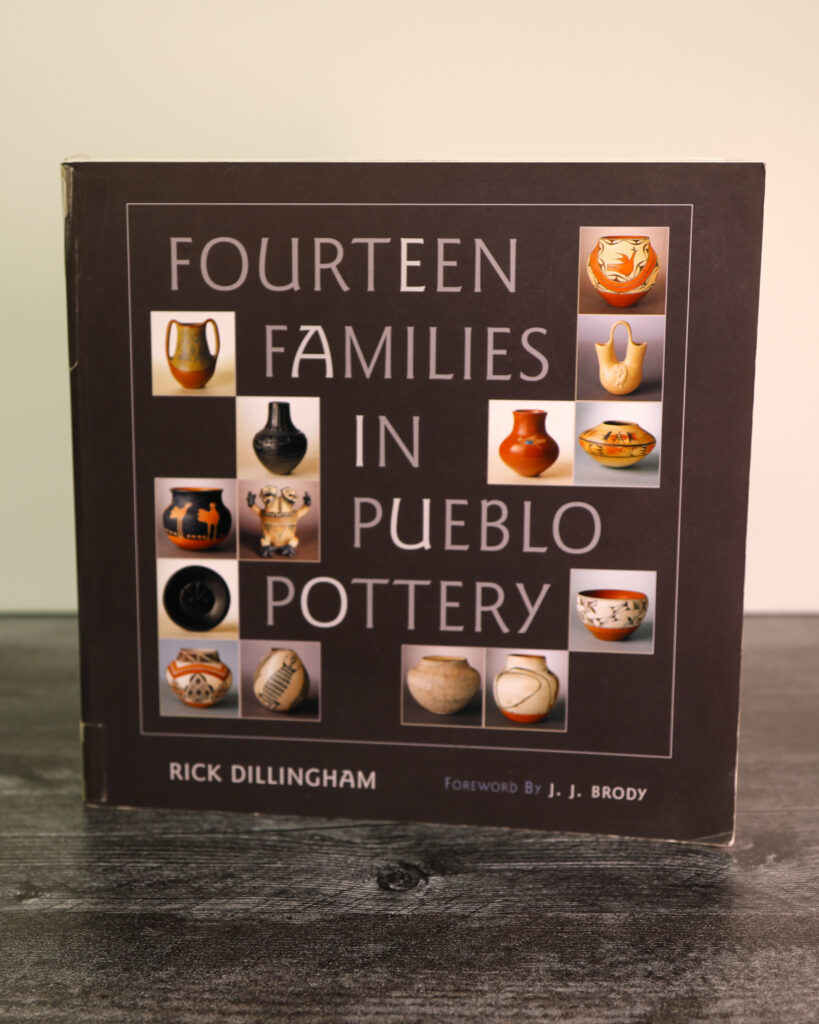
Fourteen Families in Pueblo Pottery
Rick Dillingham
University of New Mexico Press, 1994
In 1974, just a couple of years before the Indian Pueblo Cultural Center opened its doors, the Maxwell Museum of Anthropology at the University of New Mexico in Albuquerque debuted an exhibit titled "Seven Families in Pueblo Pottery." Created through a large group effort among museum staff and curated by student employee Rick Dillingham, the exhibit was small in size but would prove to have a significant impact.
Author Rick Dillingham's interest in Pueblo pottery first began when he was a teenager intrigued by ceramic arts in general. That interest led him to become a potter himself while also studying Pueblo pottery. By the early 1970s, Dillingham was an accomplished potter, collector, scholar, and occasional dealer in Pueblo pottery. The 1974 exhibit grew out of his personal collection, artistic interests, and friendships with Pueblo artists and families. More importantly, though, the exhibit and catalog reflected Dillingham's insight that the "who" behind each piece of pottery mattered just as much as the "where."
The Maxwell Museum documented the exhibit in a catalog titled 7 Families in Pueblo Pottery. That modest catalog went on to have a wide reach. Originally, exhibition brochures were limited to editions of about 2,000 copies. This catalog repeatedly sold out and demand gave no indication of slowing. J.J. Brody, curator of the Maxwell Museum (1962–1985), later shared, "Having no desire to see the museum go into the book publishing business, I contracted with UNM Press to have them handle future printings." Over 15 printings and more than 80,000 copies later, this catalog became highly influential among collectors and those who wanted to learn more about Pueblo pottery.
What spurred this demand? In the early 1970s, unless you were among the most knowledgeable of Pueblo art, most people knew very little about specific Pueblo potters and painters. Dillingham's insight led to an exhibit and accompanying catalog that created a place where Pueblo artists could be recognized equally for their works as artists as well as their ties to traditional communities. The public noticed, and they wanted more.
Twenty years later, Dillingham reflected on the original catalog's success and acknowledged its impact and limitations. No value judgments about individual talents or family importance were intended. While there was limited representation of Pueblo pottery families in the exhibit, it was never intended as a comprehensive survey or ranking of skill, talent, or importance. Rather, the catalog largely reflected Dillingham's personal preferences, friendships, and collaborations among Pueblo artists and families. In 1993, Dillingham returned to explore among these same families how attitudes and traditions about pottery may have changed or strengthened in a new generation. This, in turn, would lead to the publication of a newly revised and expanded edition of the catalog, Fourteen Families in Pueblo Pottery.
Dillingham notes in his foreword that while there are many exceptional Pueblo potters who may work alone, or who are part of a new generation not connected to an extended legacy, this revised edition would focus on potters who belong to families in which at least three generations have been active potters and/or painters. The seven families in the original catalog are still included in this update, along with seven additional families.
Beautifully organized by Pueblo, each chapter is headed by a two-page chart of family lineage. Photos of each artist are highlighted, along with full-page color photographs of their work. Family photos are included with each artist's profile, along with personal reflections on their style, inspiration, or family influences.
Today’s reader has many catalogs and publications about individual Pueblo artists and families available to choose from. Dillingham’s work, however, should be recognized for creating something not previously available to the public: an opportunity to know and appreciate not just the style and technique of a beautiful piece of pottery, but also the story of the artist who made it.
We invite you to learn more about the many talented Pueblo artists from our 19 Pueblos. Come discover your next favorite read in the IPCC Library!