
Join us in celebrating the Indian Pueblo Cultural Center’s 50th anniversary through the stories, knowledge, and voices represented in 50 special books from the IPCC Library collection. This curated selection features titles for readers of all ages and interests, offering meaningful ways to explore, honor, and celebrate Pueblo culture.
Each week, for the remainder of 2026, we will spotlight one or two featured titles. The selected books are available to view in the IPCC Library Tuesday through Saturday, 9 a.m.–5 p.m.
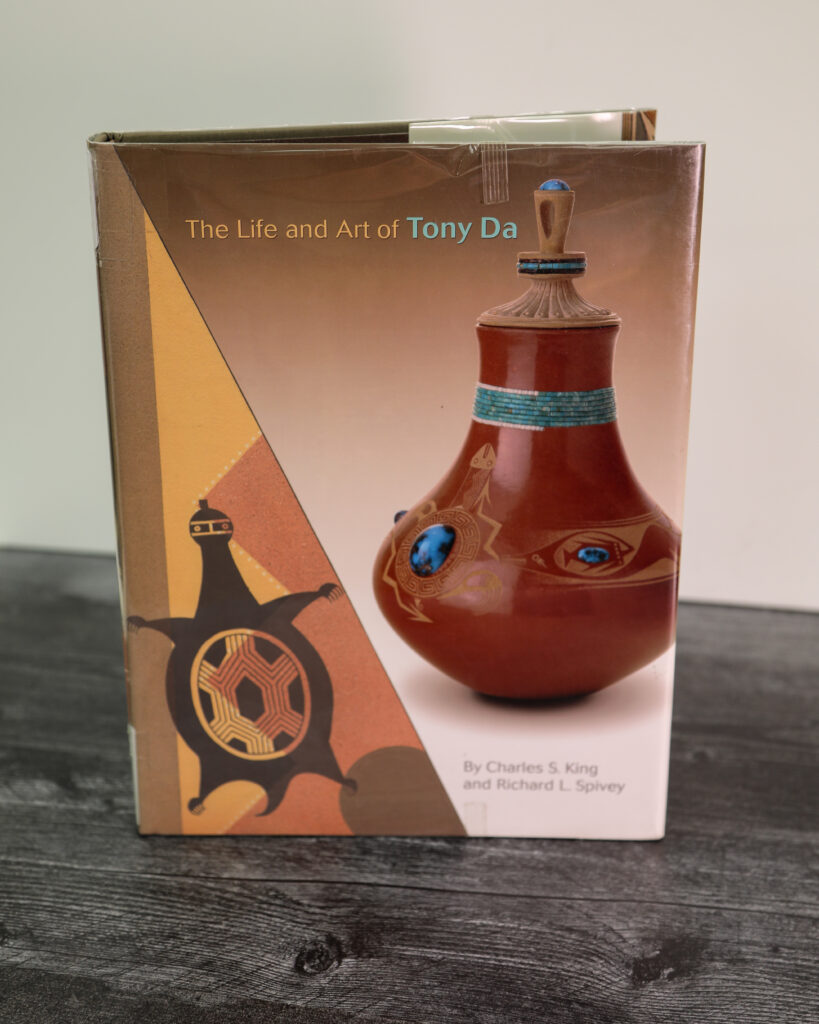
The Life and Art of Tony Da
Written by Charles S. King and Richard L. Spivey
Rio Nuevo Publishers, 2011
For the past few weeks, selections in our 50 Books for 50 Years series have highlighted Pueblo pottery and the influential families whose talent and artistry changed how it was perceived worldwide. We gave special attention to Maria Martinez (San Ildefonso) and the significant contributions that she, her husband Julian, and their children made to Pueblo pottery. Their grandson Tony Da (pronounced “day”) continued the family legacy by challenging ideas about what Pueblo art was and could be through his innovative pottery and paintings. His work departed from traditional Pueblo pottery and challenged expectations in the art world. Unfortunately, his career was abruptly interrupted, leaving many to wonder what he might have achieved.
Tony Da, born in 1940, showed an early interest in art, particularly painting. His talent was recognized early; as a youth, he even won a Hallmark card contest. Later, while attending Western New Mexico University in Silver City, Da was exposed to prehistoric Mimbres pottery, which would influence both his paintings and pottery throughout his brief career.
After returning from the Navy in the late 1960s, Tony lived with his grandmother, Maria, for about six years. Maria’s influence led Tony to focus on pottery. He showed great talent and, in 1967, began producing animal sculptures, a newer form of Pueblo ceramic art. Tony was an innovator, constantly pushing to transform his art into something unique and always striving for perfection. He was the first to incorporate turquoise into pottery, along with coral, shell, and heishi. Tony’s creativity continued to expand as he broke away from traditional Pueblo pottery techniques, exploring new ways to incorporate etched sgraffito designs into clay and using a torch to create his black and sienna pots. His art quickly became highly sought after, and Tony’s status skyrocketed as he became something of an art superstar. Unfortunately, Tony’s creative career was tragically cut short by a motorcycle accident, leaving behind a body of work created over just 15 years.
“The Greek tale of Icarus is a cautionary one that has been told for centuries. Replace the name Icarus with Tony Da and Daedalus with Popovi Da, and the beautiful and tragic story of these two artists is told in brief.” (Introduction)
This book was a collaborative effort between authors Charles S. King and Richard L. Spivey. Spivey, who had already written books about the legacy of Maria Martinez, was asked over lunch what subject in the field of American Indian art needed a book. His response was immediate: “A book on Tony Da’s paintings.” When asked if he would write the book, his answer was also immediate: “No.” At the time, the work required for a book like this felt overwhelming to him. However, the idea would not rest, and fortunately for readers everywhere, someone suggested that he co-author the book.
Published in 2011, three years after Da’s passing, this well-thought-out biography offers an intimate portrayal that balances both the brilliant and sometimes volatile aspects of Tony Da’s world. The book features full-color plates that showcase in intricate detail the paintings, animal sculptures, and Mimbres-inspired art that remain highly sought after by art historians and pottery collectors worldwide. Together, the text and images allow readers to develop a deeper understanding of who Tony Da, once referred to as a Pueblo pottery “rock star,” was and why his work remains so influential today.
We invite you to come see us in the IPCC Library to explore this story as well as the many other wonderful books we have about Pueblo artists. Come discover your next favorite read in the IPCC Library!